


An AI food scientist (



brief into (
) a compliant, (
) trend-aware formulation in (
)
hours, not months (
)
) for FMCG teams (
) turning a product


AI PROJECT
SYSTEM DESIGN
•
UX DESIGN
•
Olif – AI Powered NPD
(New Product Devlopment)
Coded on Claude
Built with AWS
•
This project explores how AI can transform the way FMCG companies develop new food products, reducing the time spent on research, formulation, experimentation and validation.
The proposed service acts as an intelligent food-science partner, helping teams move from an initial product idea to a tested, market-ready concept faster, while keeping human expertise at the centre of the decision-making process.
PROJECT CONTEXT
8 Weeks
System Design | UX Design
UI Design
COMPANY

Entry for YCombinator

Easycoder
ROLES & RESPONSIBILITIES
User Research, Mapping, Problem Solving, Prototype, Design Visuals, User Testing
TOOLS USED

Claude Code

Figma
CONTEXT
How it all started ?
The project began through conversations and work with two companies in the FMCG ecosystem. Although they operated at different points in the product-development chain, both revealed how much time, uncertainty and rework can sit between an idea and a finished product.

Formulation expertise doesn't always prevent downstream problems.
Pure Blend Wellness
A women-led company founded by two food scientists developed its own health powder, taking the product from formulation through production.
The product was developed with significant scientific expertise, but regulatory requirements became a challenge after production. One of the ingredients / intended product claims did not meet the requirements for the New Zealand market, creating the need to revisit the product and its compliance.

Every iteration creates a delay further down the supply chain.
Pacific - Flavours and Ingredients
The second perspective came from a company that produces and distributes ingredients to multiple FMCG businesses.
They regularly work with companies developing new products, supplying ingredients for their experiments and formulation trials.
From their experience, product development can involve multiple rounds of sampling and reformulation before a company is confident enough to place a full-scale order.
CONTEXT
The changing
landscape of FMCG
The market moves fast. Product development doesn't.

Consumers expect more : Changing tastes, new health needs and emerging trends are pushing brands to continuously develop new products.

Products must meet more constraints. Every formulation must balance taste, nutrition, cost, claims, regulations and manufacturability.
R&D has to do more with the same expertise. Scientists still rely on specialised knowledge and physical experimentation, while the volume and complexity of product development continues to grow.
RESEARCH
Why Food and Beverages in FMCG ( Fast Moving Consumer Goods) ?
FMCG encompasses diverse product categories, each with its own development challenges. This project focuses specifically on food and beverages, where formulation, sensory testing, nutrition, claims and ingredient interactions create a particularly complex product-development process.
A growing market
NZs food-processing &consumer-food sectors continue to expand, creating opportunities for new brands, products and categories.

Constant product innovation
Changing lifestyles & consumers are driving demand for new formats, healthier products, functional foods & convenient offerings.
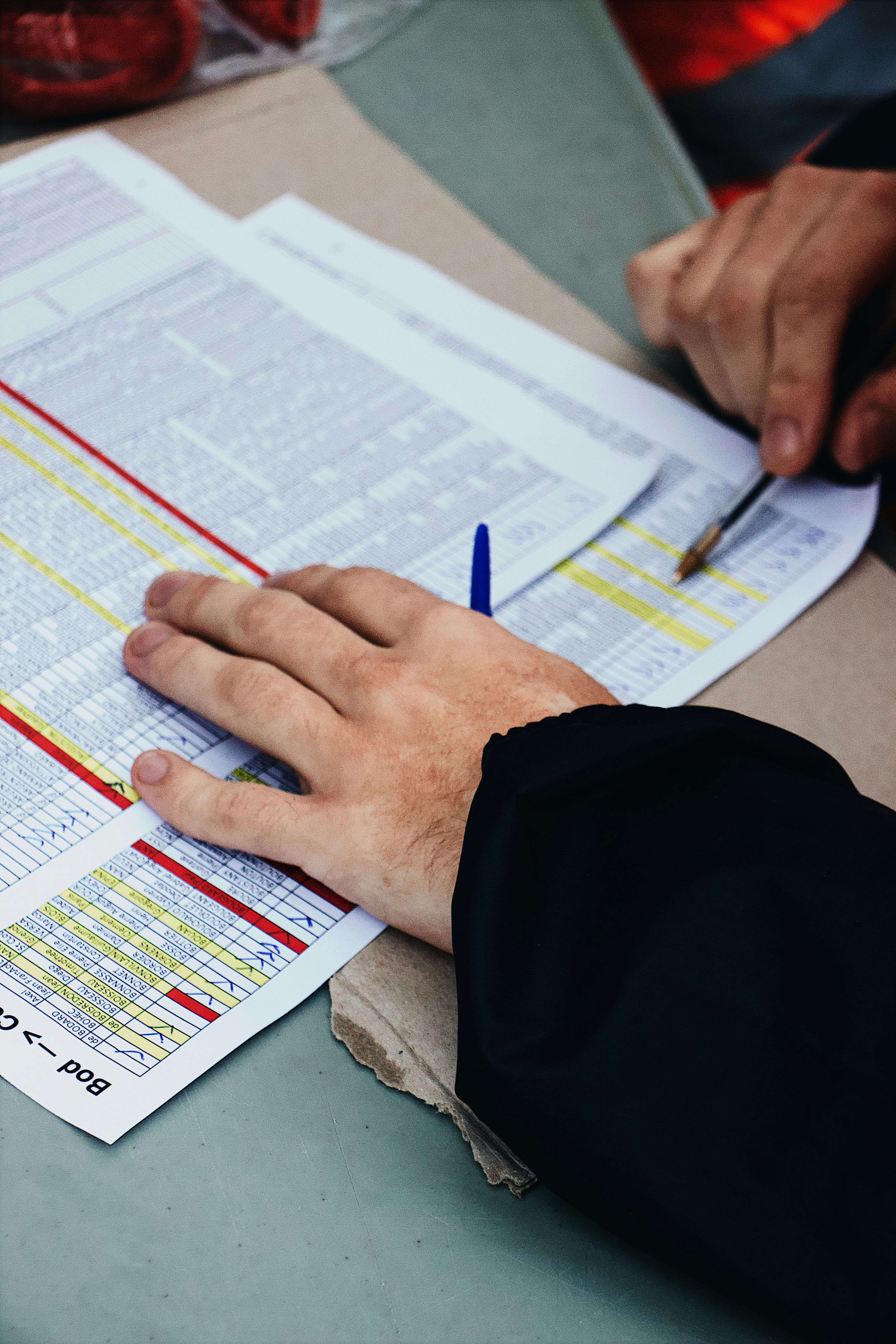
Shifting regulatory landscape
Food regulations, ingredient restrictions and permissible claims can influence whether a product is viable across different markets.

Beyond Packed Products
Formulation intelligence could extend to supporting restaurants, & food-service businesses in developing recipes at scale.
RESEARCH
Market Value in New Zealand
A strong food industry creates a strong need for better R&D infrastructure.
01 A major export industry in New Zealand
Food and beverage exports make up 64% of New Zealand's total merchandise exports.
02 A high-value innovation ecosystem
New Zealand's food and fibre sector is expected to generate NZ$64.3B in export revenue in the year to June 2026, with processed food and other products contributing an expected NZ$3.5B.

Existing solutions support different part of the NPD Workflow

Competitve Analysis
As AI enters food product development, existing solutions are beginning to support different parts of the NPD workflow, from ingredient discovery and formulation to sensory prediction, regulatory checks and product intelligence. I looked at these tools to understand where they create value, what they leave to the food scientist, and where an opportunity still exists.
Can AI change the way FMCG products are developed?
The initial exploration began with a broader question:
how could AI support industries that still depend heavily on specialised human knowledge?
FMCG product development emerged as an interesting opportunity because creating a new food product involves extensive research, formulation, experimentation, testing and regulatory validation — often through multiple iterations.
This led to three major questions
01
How does a food product actually get developed?
02
Where are the biggest challenges in the process?
03
What part of this process could AI meanigfully support ?
How does a food product actually get developed ?
STAKEHOLDERS
Who is involved ?
Bringing a new FMCG product to market requires coordination across commercial, technical, regulatory and manufacturing teams. Each stakeholder contributes different knowledge and evaluates the product against different criteria.

Everyone contributes to the same product, but each team works with a different part of the information. The food scientist is at the centre of the product-developmentactivity but depends on information from almost everyone around them.

PRIMARY RESEARCH
Hearing from People behind NPD
To understand where time and effort are actually spent during food product development, I spoke with food scientists and NPD professionals involved in formulation, testing and product validation. The conversations helped me move beyond the process map and understand the decisions, workarounds and frustrations that sit behind each stage.

Kaveri
Managed NPD and compliance in FMCG businesses & PBW

Abhy
NPD technical and experience in manufacturing & packaging at P&G
People I worked with
How does the process work ? From brief to shelf
Developing an FMCG product is a collaborative process involving sales, technical, NPD, quality, manufacturing and the customer. Each stage introduces its own reviews, approvals and dependencies before a product can reach the shelf.
UNDERSTANDING THE INDUSTRY

Where are the biggest challenges in the process?
UNDERSTANDING THE USER
Food Scientist's Perspective
From the food scientist's perspective, product development is a continuous cycle of formulating, testing, evaluating and reformulating. A formulation must satisfy multiple requirements simultaneously — from sensory and nutritional targets to cost, claims and manufacturing feasibility.


UNDERSTANDING THE USER
Problems Identified
01
Formulation is trial-and-error
Developing the right product requires repeated formulation, sampling and testing, with each unsuccessful iteration adding days or weeks to development.
02
Every change creates a ripple effect.
Changing one ingredient can affect nutrition, cost, sensory performance, claims, shelf life and manufacturability, forcing teams to revisit multiple decisions.
03
Information is fragmented.
Ingredient data, specifications, formulations, , claims and regulatory information are spread across different systems, making information slow to find and easy to duplicate.
04
Validation can happen too late.
Regulatory claims or manufacturing constraints may only surface after significant development work, sending the team back into another costly iteration.
Insights - Affinity Mapping
Developing an FMCG product is a collaborative process involving sales, technical, NPD, quality, manufacturing and the customer. Each stage introduces its own reviews, approvals and dependencies before a product can reach the shelf.
UNDERSTANDING THE INDUSTRY


INSIGHT
Goals and Oppurtunities
Problem: Information is scattered
Bring relevant information into one workspace
Problem: Formulation is iterative
Help generate and compare formulation options
Problem: Changes create ripple effects
Show the impact of formulation changes
Problem: Problems are discovered late
Flag potential issues earlier
Scientist need approval
Keep approval and decision-making human-led
UNDERSTANDING THE INDUSTRY
How might we
Use AI in FMCG companies to accelerate product development and reduce time-to-market, without compromising scientific rigour, quality or compliance?
What part of the process will AI meaningfully support?
AI proposes. The scientist decides.
Developing an FMCG product is a collaborative process involving sales, technical, NPD, quality, manufacturing and the customer. Each stage introduces its own reviews, approvals and dependencies before a product can reach the shelf.
SOLUTION

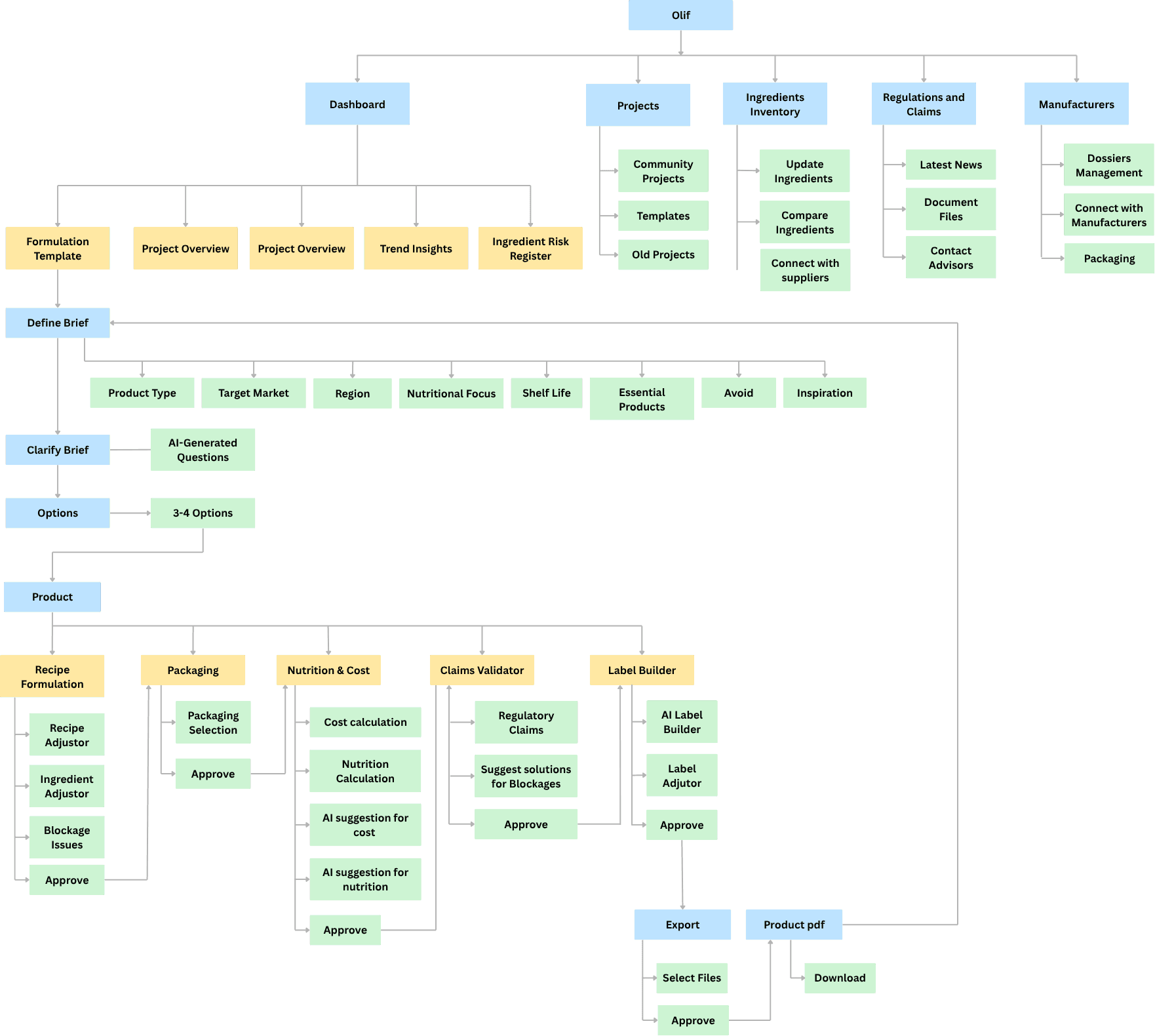
Information Architecture
Developing an FMCG product is a collaborative process involving sales, technical, NPD, quality, manufacturing and the customer. Each stage introduces its own reviews, approvals and dependencies before a product can reach the shelf.
SOLUTION
SOLUTION
AI Food Scientist - Dashboard
User-facing dashboard designed for NPD and technical teams to streamline the FMCG product development journey. It brings together AI-assisted formulation, ingredient and regulatory checks, packaging, nutrition, costing and final documentation—helping teams move from an initial product brief to a manufacturing-ready hand-off with greater clarity and less manual effort.

Dashboard
A central workspace to track active projects, revisit previous formulations and start new product briefs.
Previous Projects
A searchable record of past formulations and their development journey.
Templates
Ready-made product foundations that help teams move from an idea to a workable formulation faster.
Ingredient Risk Register
Flags ingredients that could create regulatory, sourcing or formulation challenges.
Trend Insights
Surfaces emerging consumer and market signals to help teams identify relevant opportunities before they peak.
Formulation
From brief to recipe, AI guides teams through the formulation process clarifying requirements, exploring relevant product directions, and generating a recipe that is ready for review.

Step 1 : Set the foundation
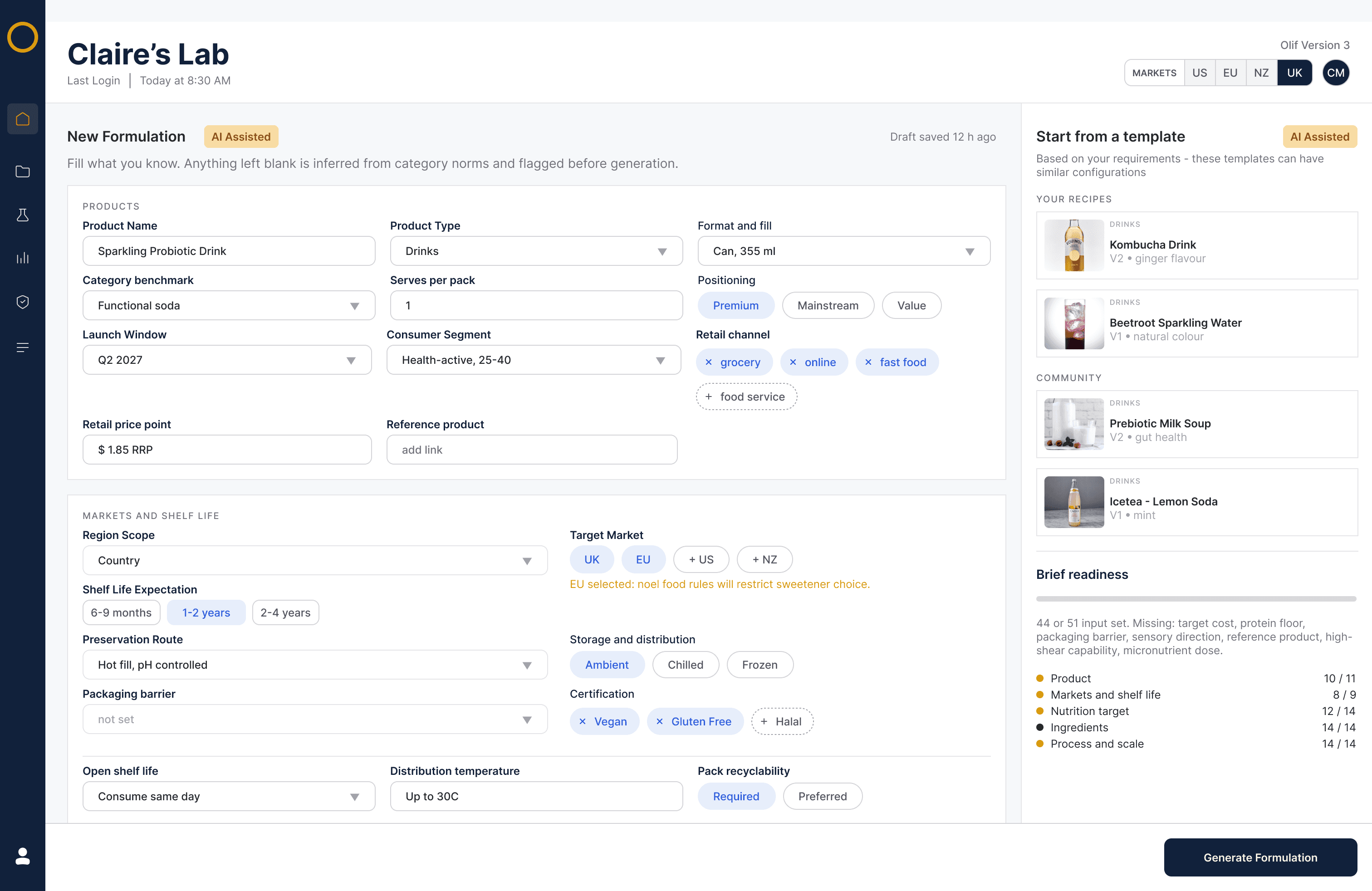
Enter the key product requirements, from product type and target market to nutritional focus, shelf life and product preferences. This initial brief gives AI the context it needs to guide the formulation process and identify important requirements from the start.

Step 2 : Define the Brief
Start by entering the product requirements, from category and target market to shelf life, positioning and packaging. AI uses the information provided to identify gaps, suggest relevant templates and flag requirements that may affect the formulation.
Templates
AI suggests ready-made templates simialr to the kind of product that being built - this gives the product a foundation that help teams move from an idea to a workable formulation faster.
Step 3 : Redefine the Brief
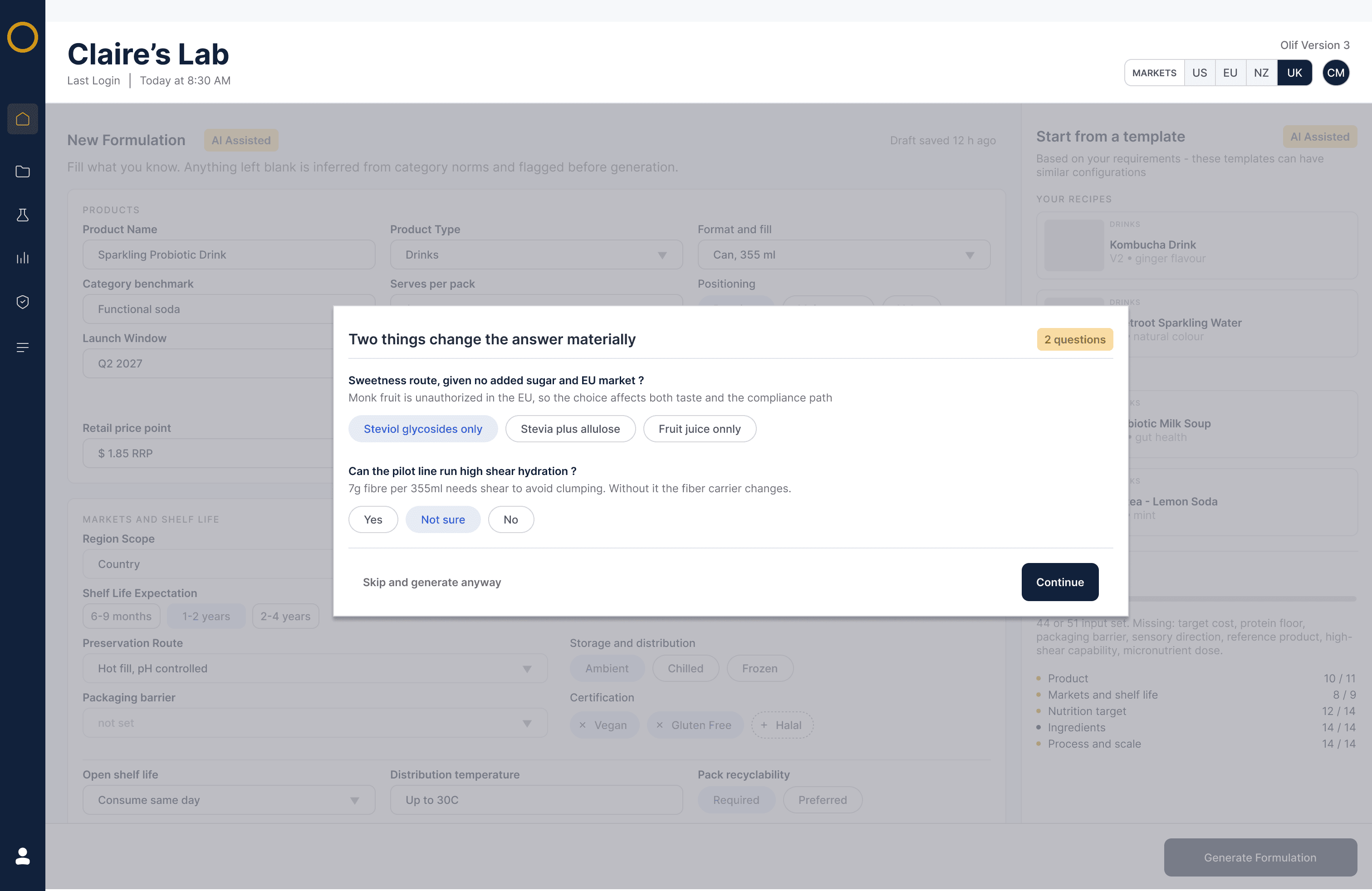
After the initial brief is entered, AI identifies the missing decisions that could materially change the formulation. It asks targeted questions around ingredients, processing and technical feasibility, allowing the user to refine the brief before moving forward.
Step 3A : AI Formulation Process
Once the brief is confirmed, AI works through the formulation in real time. It analyses constraints, screens ingredients, explores viable formulation routes and checks technical and market requirements, giving the user visibility into what is happening before the final options are generated.

Step 4 : Compare & Choose Options
AI presents multiple formulation options, each optimised for a different priority such as cost, clean label, speed or overall fit. Users can compare ingredients, processing time, sensory profile and compliance side-by-side, with AI explaining why each option fits the brief before selecting the most suitable direction.

Step 5 : Recipe Generation
The selected formulation is translated into a detailed recipe, with exact ingredients, quantities, nutritional information and preparation steps.
Ingredient Adjustments
The screen allows users to adjust individual ingredients, quantities and formulation choices while building the recipe. Changes can be made directly within the formulation to better match the selected product requirements.
Blocking Issues
The system flags ingredient, regulatory or formulation issues as they arise, allowing users to identify potential blockers early and make the necessary changes before progressing further.

NPD Process
Developing an FMCG product is a collaborative process involving sales, technical, NPD, quality, manufacturing and the customer.


Packaging
AI uses the requirements defined in the initial product brief, such as format, volume, target market, shelf life, material and distribution conditions, to suggest packaging options that are compatible with the product and its intended use.
Packaging Visual
AI generates a visual of the recommended container, helping users quickly visualise the final packaging.
Evaluation and Changes
Users can compare and change packaging options, while viewing cost, capacity, material and shelf life. AI re-evaluates downstream requirements with every change.

Nutrition & Cost
The selected ingredients, packaging and process are combined to calculate the product’s overall cost and nutritional profile. These values are compared against the targets defined in the initial brief.
AI Cost Optimisation Suggestions
AI suggests specific changes to reduce cost, such as adjusting ingredients, packaging or process steps, while showing the impact of each change.
Target Tracking
Users can see how the current formulation meets or falls short of the original nutrition targets, making it easy to identify what still needs adjustment.

Claim Validator
The formulation is evaluated against country-specific regulations, ingredient policies and claim requirements, highlighting current blockers as well as potential issues that could affect future markets.
AI Resolution Suggestions
AI identifies potential regulatory and claim blockages and suggests changes to the recipe or formulation that can resolve them before they impact later stages.
Human Review
Users can connect with a regulatory reviewer when an issue requires expert validation, ensuring the formulation is reviewed before moving forward.

Label Builder
AI generates a visual preview of the product label using the formulation, claims and product information, allowing users to quickly visualise the final pack. The label remains fully editable, so text, claims, layout and other elements can be adjusted easily before finalising.

Final Hand-off
The final hand-off brings together everything needed to move the product into the next stage, including the approved formulation, process instructions, compliance documentation, label artwork and confirmed cost. Only validated and relevant information is included, while unresolved issues or missing approvals are clearly flagged before export.

Final Manufacturing Dossier
The final PDF consolidates all validated documents required for manufacturing into one exportable dossier. It brings together the formulation sheet, process instructions, compliance documentation, label artwork, costing and key product specifications, creating a single source of truth that can be shared directly with the manufacturing team.