Introduction

About the Project

System Design

UX Design

UI Design

System Design

UX Design

UI Design

Olif: AI-Powered SaaS Platform
for FMCG Innovation
Olif: AI-Powered SaaS Platform
for FMCG Innovation

This project explores how AI can transform the way FMCG companies develop new food products, reducing the time spent on research, formulation, experimentation and validation.

The proposed service acts as an intelligent food-science partner, helping teams move from an initial product idea to a tested, market-ready concept faster, while keeping human expertise at the centre of the decision-making process.

This project explores how AI can transform the way FMCG companies develop new food products, reducing the time spent on research, formulation, experimentation and validation.

The proposed service acts as an intelligent food-science partner, helping teams move from an initial product idea to a tested, market-ready concept faster, while keeping human expertise at the centre of the decision-making process.

Impact: Reduced NPD (New Product Development) cycle time by 70% reducing manual workload while keeping human food scientists in full creative control.

Project Details

Project Timeline

8 weeks

Tools Used

Claude Code, Antigravity

Figma

Company

Easycoder - Y Combinator Entry

Roles and Responsibilities

User Research, Mapping, Problem Solving, AI Prototype, Design Visuals, User Testing

Chapter 1

Discovery and Market Context

How it all Started ?

The project began through conversations and work with two companies in the FMCG ecosystem.

"Formulation expertise doesn't always prevent downstream problems"

Pure Blend Wellness

PBW developed a health powder from formulation to production. Despite strong scientific grounding, post-production regulatory hurdles in New Zealand, required a complete product and compliance review.

"Every iteration creates a delay further down the supply chain"

Pacific - Flavours and Ingredients

FMCG ingredient distributor, they noted that supplying ingredients for new product trials often involves multiple round of formulation before a full-scale order.

The Core Problem

From Brief to Shelf:

Why Food Innovation Takes 12–18 Months

The Reality of Food Scientist

Food scientists don't just "cook"—they balance a complex matrix of

  • Nutritional limits,

  • Cost constraints,

  • Sensory targets,

  • Ingredient availability, and

  • Country-specific food safety regulations.

Chapter 2

Ecosystem and Process Bottlenecks

The Stakeholder Matrix

A Matrix of Dependencies: The food scientist sits at the center of an intricate web, balancing raw ingredients, factory limits, cost targets, and legal claims.

User Research & Expert Interviews

User Research & Expert Interviews

To understand where time and effort are actually spent during food product development, I spoke with food scientists and NPD professionals involved in formulation, testing and product validation. The conversations helped me move beyond the process map and understand the decisions, workarounds and frustrations that sit behind each stage.

To understand where time and effort are actually spent during food product development, I spoke with food scientists and NPD professionals involved in formulation, testing and product validation. The conversations helped me move beyond the process map and understand the decisions, workarounds and frustrations that sit behind each stage.

People I worked with

Kaveri

Managed NPD at PBW

Abhy

NPD technical at P&G

The Bottleneck and Manual Timeline

Under the conventional New Product Development (NPD) process, food scientists spend months navigating a rigid, trial-and-error cycle. Because ingredient adjustments dynamically impact taste, shelf-life, production cost, and regional compliance, a single change mid-process creates cascading delays.

Statistics

12-18 months

per single product line

8-12 weeks

of lost time per cycle

15-30 batches

per recipe target

45-60 days

spent in lab re-sampling

The End-to-End NPD Workflow ( How does the process work?)

Developing an FMCG product is a collaborative process involving sales, technical, NPD, quality, manufacturing and the customer. Each stage introduces its own reviews, approvals and dependencies before a product can reach the shelf.

Pain Zone 1 (Formulation Loop):

Technical teams waste weeks in endless benchtop trial-and-error cycles between sample creation and internal reviews.

Pain Zone 2 (Supply Chain & Stakeholder Delay):

Disconnected feedback loops between sales, marketing, and customers force mid-stage recipe re-adjustments.

Pain Zone 3 (Late-Stage Compliance & Costing Wall):

Regulatory and cost blockages are discovered late in packaging and claims approval, forcing complete product resets.

Chapter 2 : Research

Key Bottlenecks in Product Formulation

Bottleneck Line Diagram

Bottleneck Line Diagram

Food Scientist's Perspective

From the food scientist's perspective, product development is a continuous cycle of formulating, testing, evaluating and reformulating. A formulation must satisfy multiple requirements simultaneously, from sensory and nutritional targets to cost, claims and manufacturing feasibility.

Chapter 3

Insight, Stratergy and Refined Framing

Problems Identified

Food R&D teams lose months in repetitive trial-and-error iterations, fragmented compliance checks, and scattered legacy data, delaying go-to-market and risking late-stage formulation failure.

01

01

Trail and Error

Trail and Error

Repeated sampling and testing add days or weeks with every failed iteration.

02

02

Ripple effect of changes

Ripple effect of changes

Tweaking one ingredient impacts nutrition, cost, sensory performance, claims, and manufacturability.

03

03

Fragmented Information

Fragmented Information

Critical data is siloed across sales, R&D, and regulatory teams, creating back-and-forth.

04

04

Late Stage Validation

Late Stage Validation

Regulatory or manufacturing bottlenecks surface too late, forcing costly rework.

Insights – Affinity Mapping

Developing an FMCG product is a collaborative process involving sales, technical, NPD, quality, manufacturing and the customer. Each stage introduces its own reviews, approvals and dependencies before a product can reach the shelf.

Developing an FMCG product is a collaborative process involving sales, technical, NPD, quality, manufacturing and the customer. Each stage introduces its own reviews, approvals and dependencies before a product can reach the shelf.

Competitive Landscape & Market Gap

As AI enters food product development, existing solutions are beginning to support different parts of the NPD workflow, from ingredient discovery and formulation to sensory prediction, regulatory checks, and product intelligence. I looked at these tools to understand where they create value, what they leave to the food scientist, and where an opportunity still exists.

As AI enters food product development, existing solutions are beginning to support different parts of the NPD workflow, from ingredient discovery and formulation to sensory prediction, regulatory checks, and product intelligence. I looked at these tools to understand where they create value, what they leave to the food scientist, and where an opportunity still exists.

Chapter 4

Problem Framing and Goals

How Might We Statements

HMW 1

How might we eliminate blind recipe experimentation without sacrificing sensory quality?

HMW 2

How might we expose hidden cost and regulatory failures before physical lab trials begin?

HMW 3

How might we keep cross-functional teams aligned without drowning the food scientist in manual updates?

The Stratergic Pivot

The Strategic Pivot: Why AI, and Where Does It Belong?

Solving these three challenges manually would require complex, fragmented software suites that slow down the scientist.

We decided to introduce an AI-powered co-pilot model, not to automate the creative process, but to handle heavy data synthesis and real-time matrix calculations.

Core Principle: AI is proposes and predicts; the food scientist decides

Chapter 2 : Research

Core Design Goals

Goals and Opportunitty

01

Multi-Variable Calculation Engine

System Target: Instantly project cost, nutrition, shelf-life, and regulatory compliance dynamically as ingredient parameters change.

01

Multi-Variable Calculation Engine

System Target: Instantly project cost, nutrition, shelf-life, and regulatory compliance dynamically as ingredient parameters change.

02

Unified Knowledge & Recipe Workspace

System Target: Aggregates legacy formulas, supplier spec sheets, and country rules into a single searchable workspace.

02

Unified Knowledge & Recipe Workspace

System Target: Aggregates legacy formulas, supplier spec sheets, and country rules into a single searchable workspace.

03

Scientist-in-the-Loop Workflow

System Target: Ensure every AI output is fully editable, transparent, and requires explicit human sign-off before downstream handoff.

03

Scientist-in-the-Loop Workflow

System Target: Ensure every AI output is fully editable, transparent, and requires explicit human sign-off before downstream handoff.

Chapter 4

Solution, IA & Prototyping

What part of the process will AI meaningfully support?

AI proposes. The scientist decides.

Developing an FMCG product is a collaborative process involving sales, technical, NPD, quality, manufacturing and the customer. Each stage introduces its own reviews, approvals and dependencies before a product can reach the shelf.

Developing an FMCG product is a collaborative process involving sales, technical, NPD, quality, manufacturing and the customer. Each stage introduces its own reviews, approvals and dependencies before a product can reach the shelf.

Prototype Stage 1 — Parameterization & Brief Capture (User -> AI)

Stage 1: Input & Constraint Definition.

Capture parameters early so the AI generates viable recipes tailored to specific markets and targets.

From brief to recipe, AI guides teams through the formulation process clarifying requirements, exploring relevant product directions, and generating a recipe for review.

From brief to recipe, AI guides teams through the formulation process clarifying requirements, exploring relevant product directions, and generating a recipe for review.

  • Step 1

  • Step 2

  • Step 3

  • Transition Step

  • Step 4

  • Step 1

  • Step 2

  • Step 3

  • Transition Step

  • Step 4

Chapter 4: Research

Inspiration for AI Screens

Inspiration from other AI Agents

New Product Development Process

New Product Development Process

Developing an FMCG product is a collaborative process involving sales, technical, NPD, quality, manufacturing and the customer.

  • Step 1 : Formulation

  • Step 2 : Packaging

  • Step 3 : Nutirtion and Cost

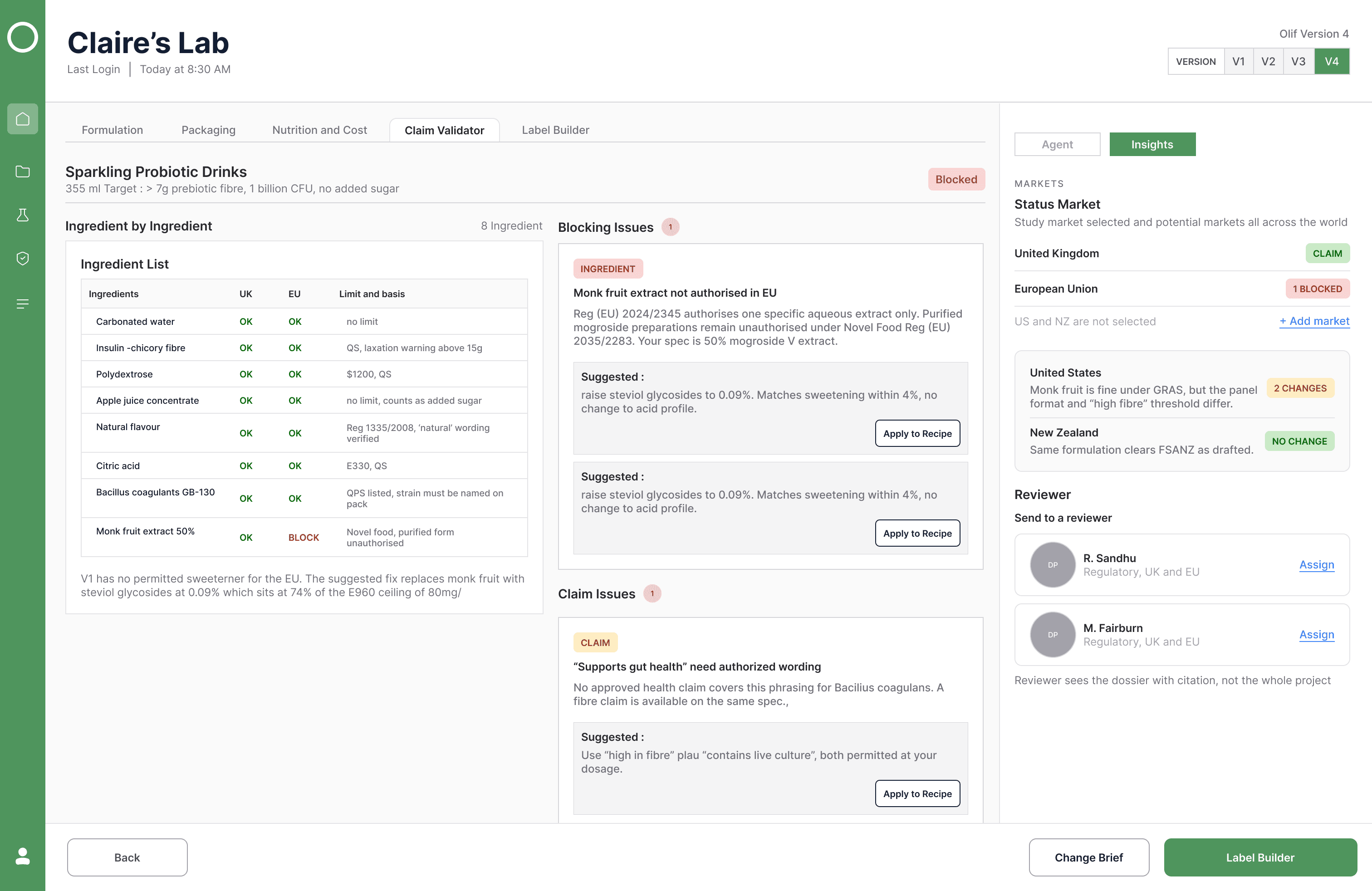
  • Step 4 : Claim Validator

  • Step 5 : Label Builder

  • Transition Step

  • Step 6 : Hand Off

  • Step 1 : Formulation

  • Step 2 : Packaging

  • Step 3 : Nutirtion and Cost

  • Step 4 : Claim Validator

  • Step 5 : Label Builder

  • Transition Step

  • Step 6 : Hand Off

Chapter 5

Impact & Business Results

Results

Olif is already demonstrating strong commercial validation through active live pilots with industry leaders Pacific Flavours & Ingredients and Pureblend Wellness (PBW). By integrating Olif into their development and compliance workflows. Olif delivers immediate, measurable efficiency on the factory floor.